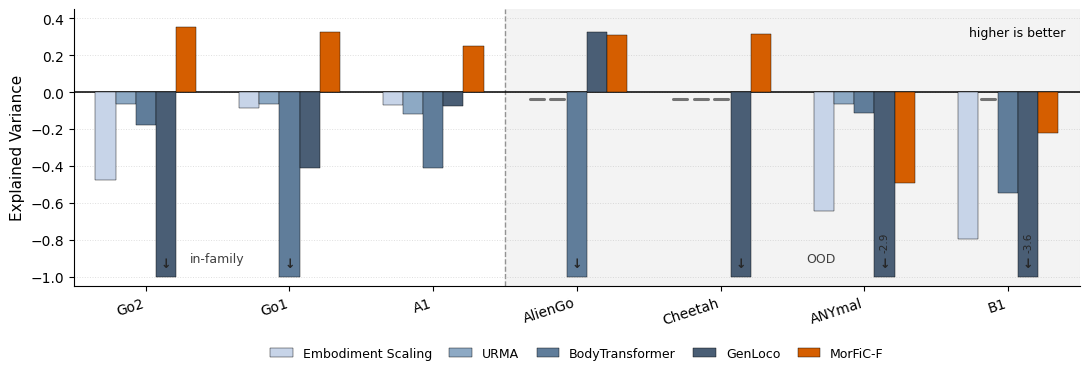
Zero-shot cross-morphology transfer A single learned policy evaluated across seven robot morphologies in simulation.
The result in one glance
One policy. Different bodies.
MorFiC takes a different route to generalization: improve the value function so a policy trained on one source robot can transfer efficiently, rather than relying on target-specific retraining or very large multi-embodiment training budgets.
1source robot
7simulated morphologies
2real robot platforms
≈2hsingle-source training
Efficient generalization
Not brute-force scaling. MorFiC targets a specific actor–critic failure mode — value miscalibration across bodies — enabling competitive zero-shot transfer with a compact single-source training setup.
The diagnosis
Why does zero-shot transfer break?
Across robot morphologies, the same observed state can lead to very different future returns because mass, kinematics, joint limits, and actuation change the underlying dynamics.
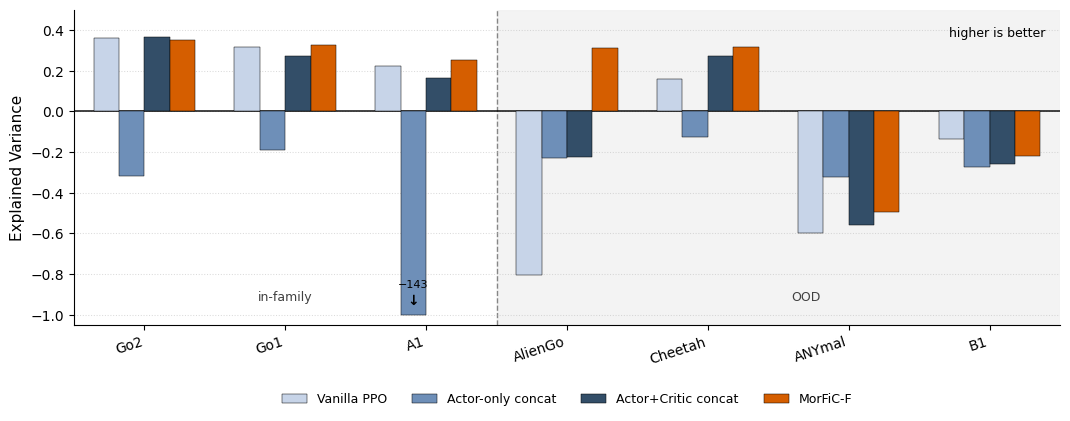
A shared critic is therefore pushed toward averaging incompatible value targets. That value bias flows directly into PPO advantage estimates — and can change the direction of policy updates.
V
The core idea: cross-morphology generalization is not only a policy representation problem. The value function must also stay calibrated as the body changes.
Method
Condition the critic multiplicatively.
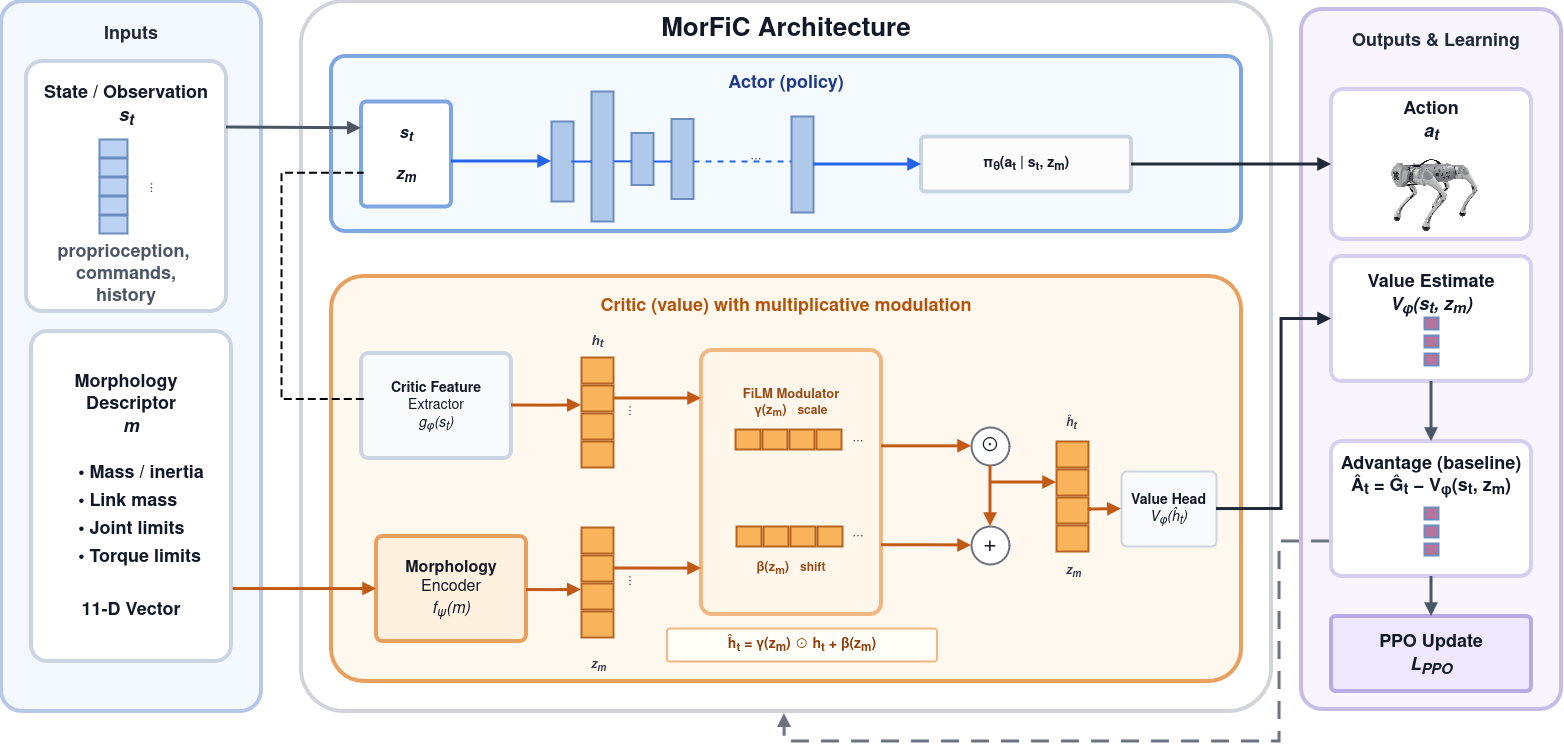
MorFiC encodes a robot morphology descriptor into a latent representation shared by the actor and critic. The critic uses morphology-aware multiplicative modulation, allowing the value landscape itself to change with the embodiment instead of treating morphology as a weak additive feature.
01
Sample morphology
Physical and control parameters are randomized around the source robot during training.
02
Encode the body
A lightweight encoder maps the morphology descriptor to a shared latent representation.
03
Modulate value
Multiplicative critic conditioning captures morphology-dependent value landscapes and improves advantage calibration.
Cross-morphology transfer
Seven bodies, zero target-robot training.
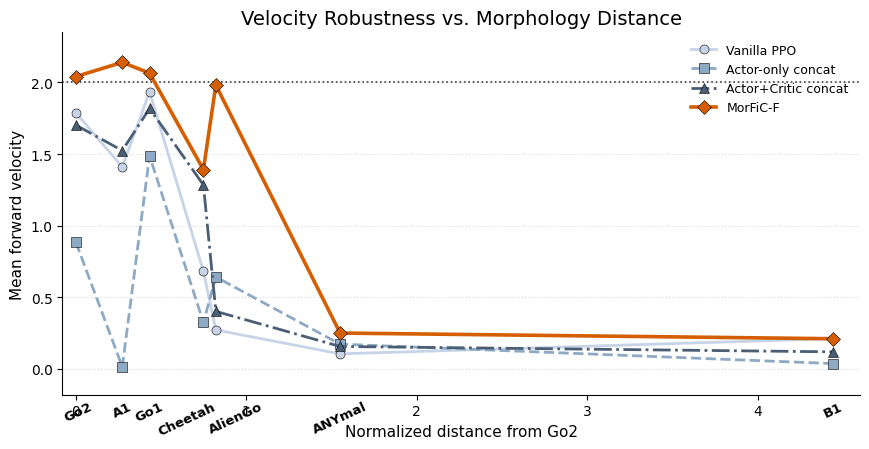
Evaluation spans Go2, Go1, A1, AlienGo, Cheetah, ANYmal, and B1. Performance remains strongest near the source morphology and degrades gracefully as the embodiment moves farther out of distribution.
Seven simulated quadrupeds Same learned policy, unseen target morphologies.
Real hardware
Same policy weights. Go1 and Go2.
MorFiC transfers from simulation to two Unitree platforms without target-specific fine-tuning, reaching approximately 1.4–1.7 m/s on Go1 and 1.1–1.3 m/s on Go2.
Zero-shot hardware deployment Indoor and outdoor runs on Go1 and Go2.
Perturbation recovery Push disturbances on real hardware.
Efficiency + evidence
Generalization without brute-force compute.
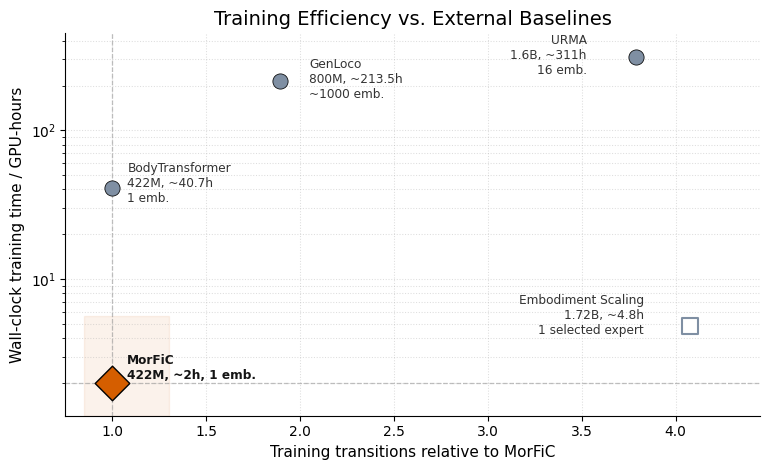
MorFiC trains on a single source embodiment in roughly two hours while retaining strong zero-shot transfer. The critic diagnostics help explain why: better value calibration yields more reliable advantages and policy updates across morphology shift.
1.98 m/sAlienGo forward velocityvs. additive PPO variants below 0.65 m/s in the reported comparison
~5×B1 speed gainrelative improvement reported against morphology-conditioned PPO baseline
0target fine-tuningfor the reported Go1 and Go2 hardware deployments
Full overview
MorFiC in 2 minutes 48 seconds.
The complete supplementary overview: motivation, method, diagnostics, simulation transfer, hardware deployment, and limitations.
MorFiC supplementary video
Stress tests + limitations
Where transfer still gets hard.
Performance falls as morphology moves far outside the training distribution. Real-world deployment is also sensitive to latency, state-estimation drift, and contact mismatch. The accompanying reel intentionally starts with failure cases, then shows additional successful hardware runs to give a fuller picture of deployment behavior.
Read the appendix → Stress tests, failures & additional hardware runs Failure cases first, followed by additional successful runs.
News & coverage
One Robot, Many Bodies.
The University of Maryland Institute for Advanced Computer Studies profiled MorFiC, its single-source training setup, critic-miscalibration diagnosis, and zero-shot Go1/Go2 deployment.
Citation
Use MorFiC in your work.
If you find the method or diagnostics useful, please cite the paper.
@article{mishra2026morfic,
  title   = {MorFiC: Fixing Value Miscalibration for Zero-Shot Quadruped Transfer},
  author  = {Mishra, Prakhar and Raj, Amir Hossain and Xiao, Xuesu and Manocha, Dinesh},
  journal = {arXiv preprint arXiv:2603.14554},
  year    = {2026}
}